


Two padel court quotes can look similar until the site work, shipping boundary, and installation responsibilities are put on the same page. A buyer comparing only the court-kit line risks committing to a price that does not describe a playable court. The useful question for 2026 is not simply “What does a court cost?” It is “What remains to be paid before the first booking?”
What a Court Price Actually Covers
Kit Price Versus Installed Price
A kit quotation may include the enclosure, glass, turf, net, and lights while leaving the slab, power supply, lifting equipment, freight, and labour to others. An installed price may still exclude planning work or remedial groundworks. Ask each bidder to mark every line as included, excluded, provisional, or supplied by the buyer. A blank is not a saving.
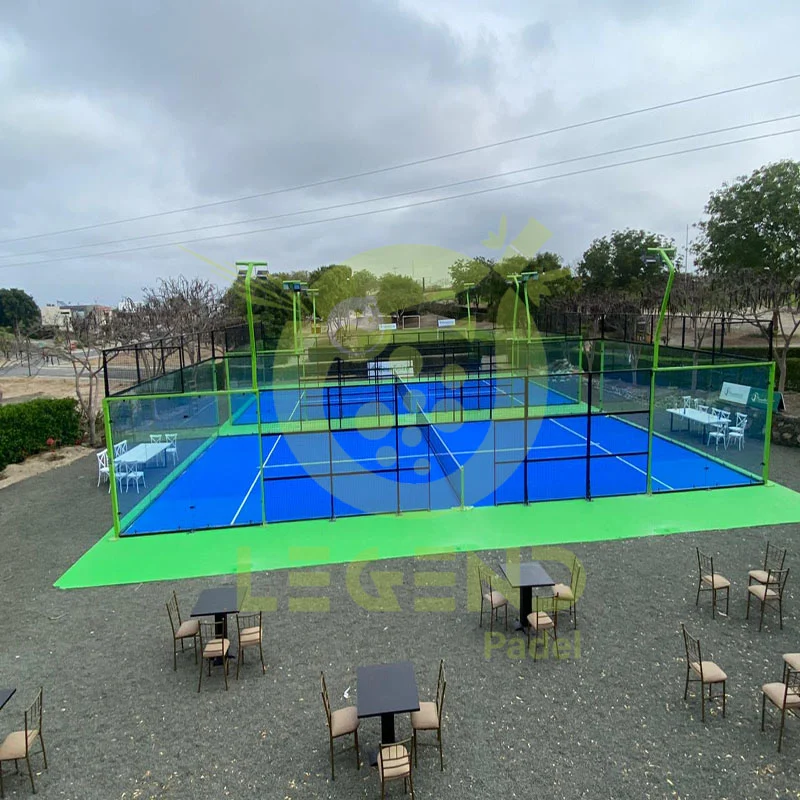
For orientation, a standard doubles court has a 20 m by 10 m playing area. The site needs more than that rectangle: allow at least 11 m by 21 m of total floor area, including peripheral space. This distinction matters before a contractor measures the slab or an operator counts how many courts fit inside a lease.
Fix the Scope Before Comparing Bids
Give bidders the same location, drawing, intended use, target installation date, and responsibility matrix. State whether the venue is indoor, exposed, or roofed, and ask for the delivery point and currency. A cheaper quote that stops at a seaport is not comparable with one that includes transport to the site and assembly.
LEGEND SPORTS offers a Padel Court Modular Foundation System as a distinct product option; it should be evaluated against the ground conditions and a local engineer’s design, not treated as a universal substitute for site preparation.
Five Hidden Factors Behind Padel Court Prices
1. Ground Conditions and Foundation
The surface beneath the kit is often the first unpriced variable. Survey access, level changes, drainage, excavation, reinforcement, and the anchor interface before ordering. A level-looking yard does not prove that its existing pavement can accept a court. Ask the installer to specify slab tolerance, fixing details, and which party remedies an out-of-tolerance base.
The playing rectangle is 20 m by 10 m, but at least 11 m by 21 m of total floor area is allowed for peripheral space. On a constrained site, that extra allowance can change the number of feasible courts, the circulation layout, and the cost of civil works. Obtain a dimensioned layout rather than estimating from a brochure image.
2. Structure, Glass, and Turf Specification
Panoramic and conventional frames are not interchangeable line items. Compare steel section schedules, finish, glass type and thickness, turf construction, infill, and documented tolerances. A vague phrase such as “premium court” says little about replacement parts or the installed result.
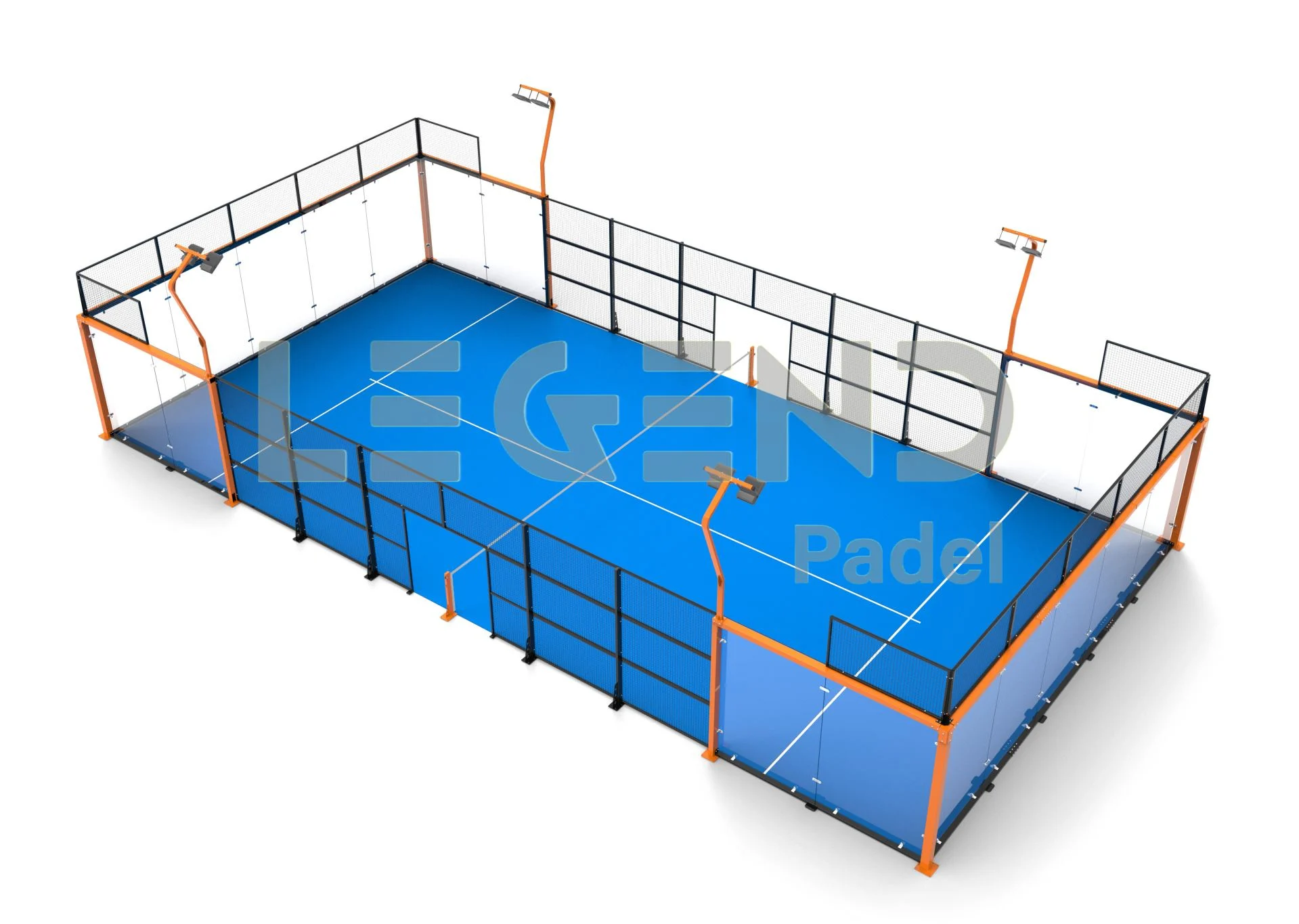
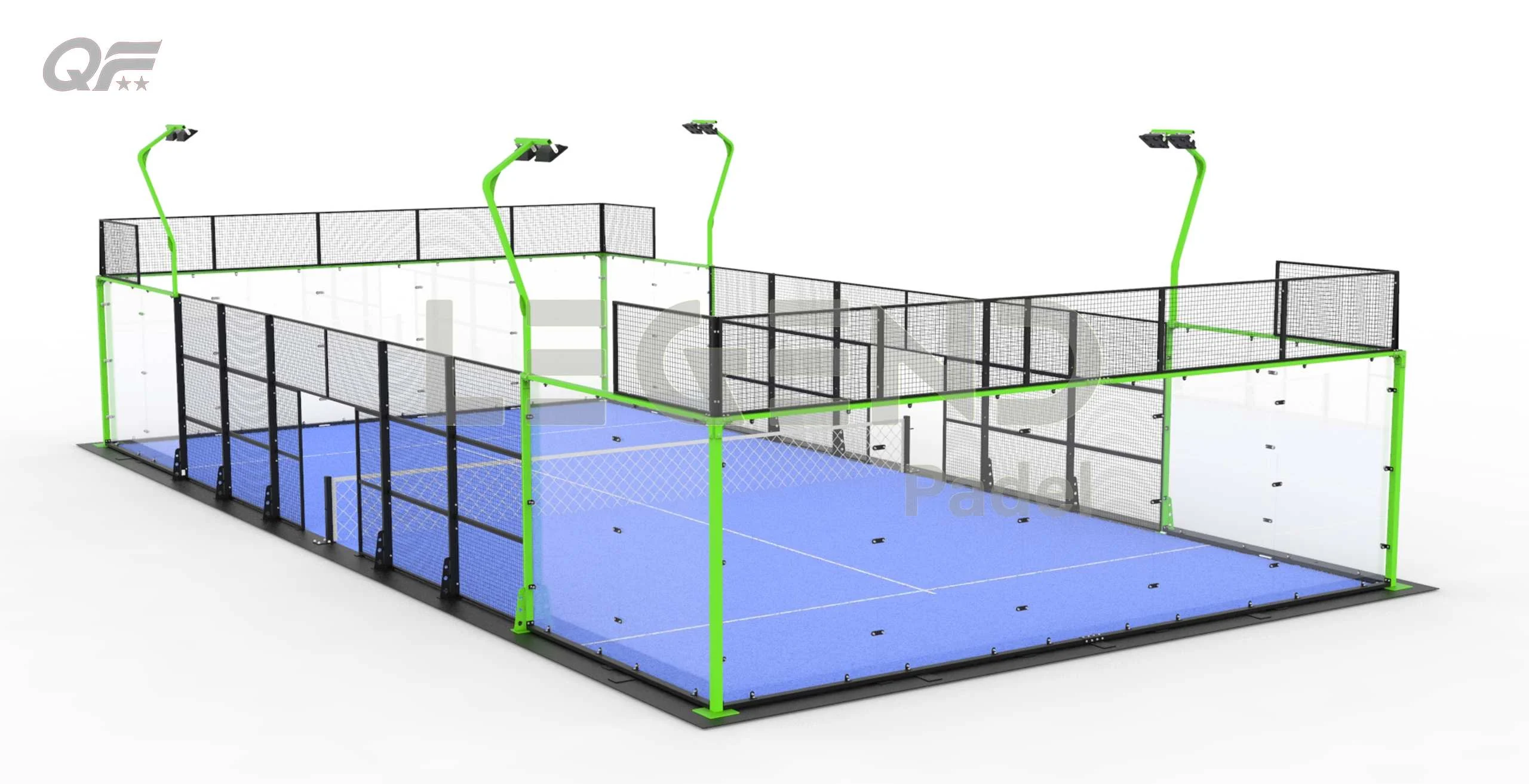
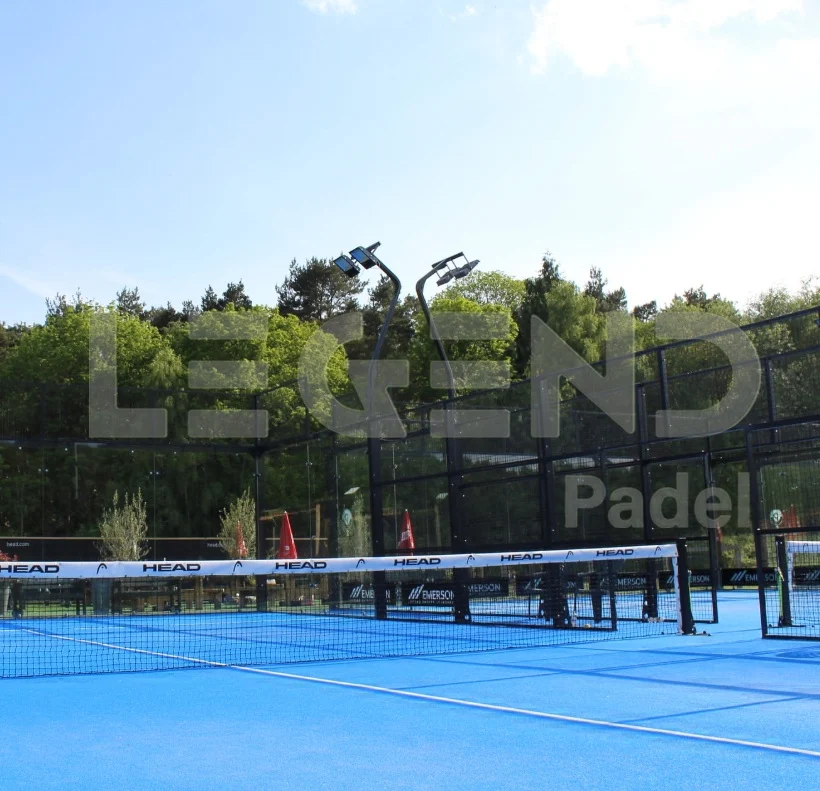
For a concrete comparison, the Pro Panoramic Padel Court-PD04 is listed as a 20 m by 10 m model. Its product specification describes 12 mm tempered glass panels, artificial turf, and eight 200 W LED floodlights. Request the exact configuration offered in the current quote rather than assuming every option shown for a model is included.
3. Lighting and Electrical Work
A lamp count is not an electrical scope. Identify mounting, cabling, controls, distribution board, local electrical certification, and the required playing-surface illumination. Indoor ambient lights may not provide suitable court lighting; outdoor poles may require a separate foundation or permit. Ask for a layout and a commissioning responsibility, not just a fixture wattage.
The PD04 specification lists eight 200 W LED floodlights at a 6 m mounting height. That is a model-specific reference point, not a design promise for every building. A venue’s ceiling, reflectance, and planned use still need an appropriate lighting design and local electrical sign-off.
4. Freight, Duties, and Site Access
Factory pricing and landed cost are different numbers. Confirm the Incoterm, packing list, shipping port, insurance, import charges, inland haulage, unloading, and any crane or forklift. Glass handling and a tight delivery entrance can turn a plausible freight allowance into an expensive variation.
Shipping can be arranged to the buyer’s local seaport after the port is specified and the cost checked. That service does not by itself include customs clearance, delivery from the port, or unloading at the club. Put each of those responsibilities in writing before comparing a direct-supply offer with a local turnkey bid.
5. Installation and Future Maintenance
Separate installer travel, accommodation, lifting, assembly, testing, and snag correction. The buyer should know who signs off anchors, glass, lighting, and the playing surface. A low assembly allowance is poor value if the team cannot mobilise when the slab is ready.
Routine care belongs in the ownership calculation too. Regular floor cleaning, replenishing the sand layer, checking the lighting system, and checking screws are maintenance tasks. Ask for spares and maintenance instructions with the quote; do not assume the initial purchase price covers later consumables or replacement labour.
Compare Two Quotations on Equal Terms
Ask for a Component Schedule
Set up a side-by-side sheet with columns for frame, glass, turf, infill, lights, foundations, freight, installation, taxes, commissioning, and warranty. Record quantities, specifications, exclusions, and the party responsible for each item. If an upgrade is offered, price it separately. That preserves a genuinely comparable base case.
The Max Pro Panoramic Padel Court-PD03 provides another named configuration for comparison. It has larger and stronger structural columns within a 20 m by 10 m court, with 12 mm tempered glass and eight 200 W LED lights in its specified configuration. Ask for the proposed section schedule and an itemised offer before assigning a premium to that distinction.
Separate Local Work from Factory Supply
For direct sourcing, mark where the manufacturer’s scope ends and the local contractor’s starts. We can customise court finishes and other specified options as a source factory, but the buyer still needs a local site assessment and an agreed installation plan. Specify the exact finish, turf colour, glass choice, and logo treatment on the purchase schedule so substitutions are visible.
The PD04 configuration offers choices of turf colour, steel-structure finish, branded logos, and tempered or laminated glass. A choice being available does not mean it is included in a base price. Require the quote revision to show the chosen variant and any effect on lead time.
Build a Contingency Without Inflating the Budget
Price the Unknowns Early
Keep a separate risk register for ground conditions, approvals, freight changes, and building services. Obtain measured local quotes for work that the court supplier cannot price reliably from a plan. A contingency is then tied to named uncertainties rather than hidden in an arbitrary percentage.
Decide Where Upgrades Earn Their Place
Pay for a feature because it meets the venue brief: visibility for spectators, a removable system for a leased site, or a specific lighting outcome. Compare the installed total and the operating implications, not just the discount on a kit. The lowest defensible 2026 price is the one with a complete, buildable scope.
FAQ
Q: Why do padel court prices differ between suppliers?
A: Court type, component specifications, foundations, delivery boundary, and installation scope differ. Compare itemised quotations against one site brief before treating a lower figure as a saving.
Q: Do padel court prices include a concrete foundation?
A: Not necessarily. Some quotations cover only the court kit. Ask whether ground surveys, slab construction, drainage, anchors, and remedial work are included.
Q: How much space should a standard padel court budget allow?
A: The playing area is 20 m by 10 m. Allow at least 11 m by 21 m of total floor area including peripheral space; confirm the actual site layout with the designer.
Q: Are lighting and electricity included in padel court prices?
A: A kit may include fixtures but not local cabling, controls, connection, or commissioning. Request an electrical scope and a lighting layout for the actual venue.
Q: What should buyers ask before accepting a padel court price?
A: Request a component schedule, a delivery term, site-work exclusions, installation responsibilities, warranty terms, and a method for pricing variations. Compare the complete installed total.