


An evidence trail needs to be established when choosing a Padel Court manufacturer for a UK project. A company’s catalogue is not proof that the configuration shown has been correctly quoted for your specific project. This guide will enable the buyer to complete a due-diligence check to distinguish between a proper standards question and a marketing blurb.
Start With the Configuration, Not the Certificate
Ask which requirements apply
Begin with the exact court configuration, intended use, and standards edition under review. Ask the supplier to map dimensions, glass, mesh, access, turf, and lighting to the quoted system. The request should name the evidence needed for each item and the person responsible for closing an open question.
Use project language to name the drawing revision, materials, and scope of evidence. This creates a traceable RFQ.
When buying a Padel Court from a UK manufacturer, treat “compliant” with suspicion until you have evidence to support the claim. What “compliant” actually means can vary greatly between manufacturer and/or supplier and even between certificates issued by the same body.
Match the evidence to the quoted court
A certificate or test report only has value if its scope matches the court for which you are purchasing. Check if changes to glass, mesh, steel, turf or lighting have created a new configuration. Keep a copy of the current plans and details of the materials used with the certificate/evidence, as you would later need to check for any possible substitutions.
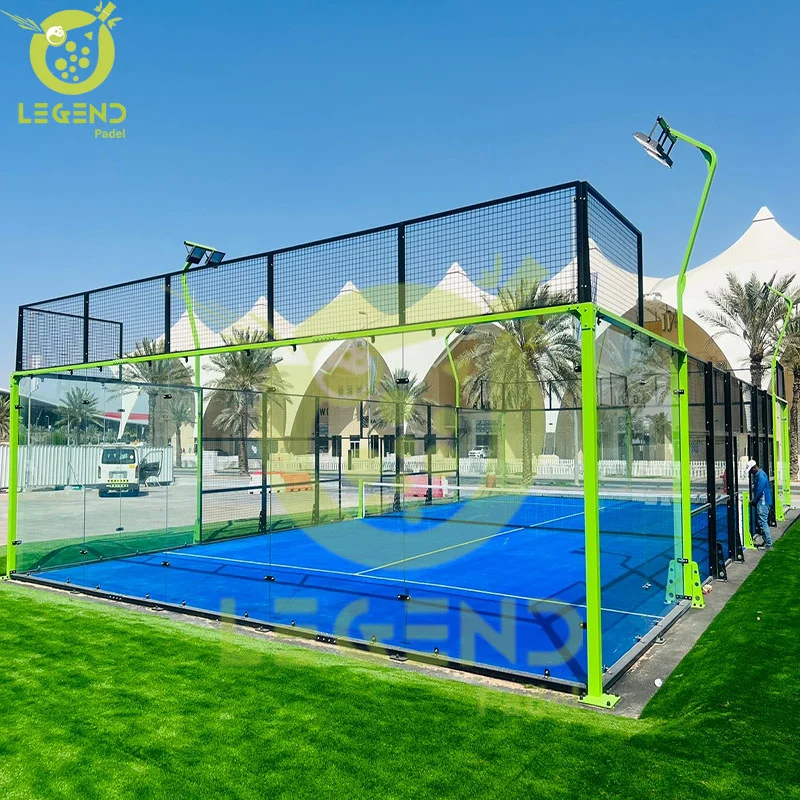
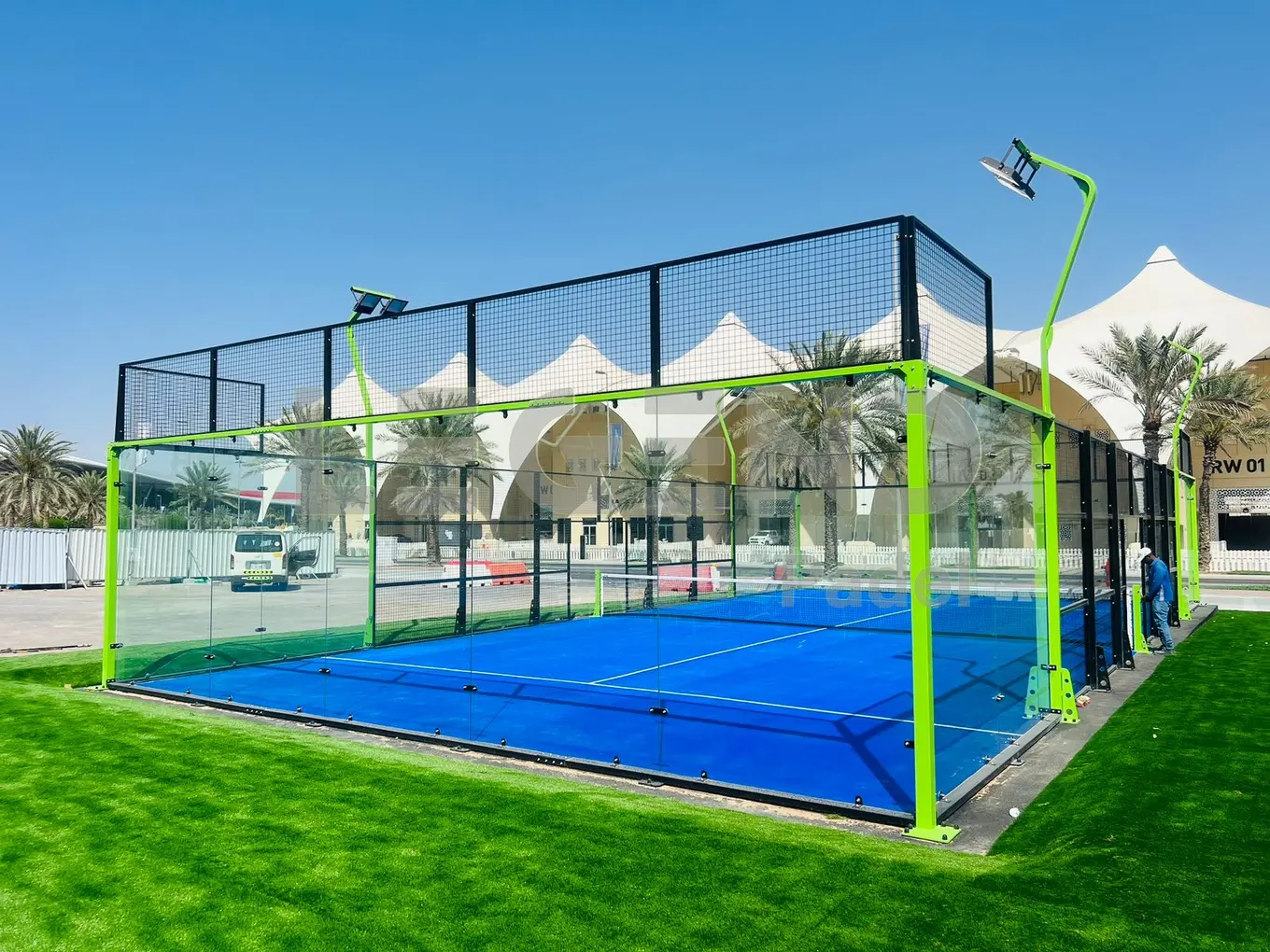
For a product reference, see the panoramic padel court product page. Treat the page as a configuration reference, then request project-specific evidence.
Review Manufacturing and Material Controls
Ask how steel components are made
A responsible Padel Court manufacturer should explain the production controls in place for its manufacturing process. LEGEND SPORTS’ production process is monitored from CNC cutting and bending through welding, surface preparation, powder coating, and curing.
The process descriptions can be used by the UK buyer to ask questions around repeatability of the coating process, coating preparation and inspection records. They do not create a zero-error guarantee of lifetime, structural performance, or 100% inspection. The questions are recorded against the quoted batch and are not to be confused with a general description of the process which would be assumed to apply to all installations.
Check the material schedule
Material review should be specific. Ensure that the approved system information includes reference to hot-dip galvanised steel, powder coating, 12 mm tempered glass, turf options and heights, LED lighting, safety-glass processing and accessory supply. Confirm which materials and finishes are included, which are optional, and which are to be supplied locally.
Make sure the material list refers to the drawings and other evidence by the same names. If a substitute material is proposed, ask who authorizes the change and how the change is reflected in the evidence submitted.
Record the finish, thickness, treatment, etc., and option status as appropriate for inspection purposes. Do not create a schedule that just lists ‘glass’ or ‘steel’ as it will not support any future replacement decision. The schedule should be a constant reference point that can be referred to by procurement, the installer and the operator.
Build a Certificate Evidence Chain
Request a complete project file
Project-specific drawings, material lists, test records, and certificates must be provided by the buyer before accepting a compliance statement as verified. The evidence file must clearly outline which court configuration each certificate or test record refers to.
When reviewing a Certificate claim against a quoted court configuration and current project scope, record the holder, issuer, scope, date of issue, test basis and any limitations. If a reference has not been provided in full, list it as an open procurement question and do not disclose it as a claim against public funds.
Create a chain before submitting your tender response. The chain shows which document addresses which requirement and where the document came from. It also shows whether professional checking has been done or not. A missing field is something that you can ask a question about, rather than assume an answer.
Trace records to production
Go into detail about labeling of components, recording of welds and coating checks, and identification of damaged or replaced parts. Traceability allows you to link the actual court to the approval documents of the project. The FIP padel court standards guide can be very useful during the discussion about the standards required for your project. However, in the end it is the project evidence that will decide on the purchasing of the court.
Check UK Site and Delivery Interfaces
Assign site responsibilities early
Checks for UK projects should include consideration of drainage, wind exposure, internal clearance, roof loading where relevant, power supply, access and maintenance routes. Who is responsible for each of these checks? Manufacturer, local engineer, building professional, installer, carrier or site owner? Manufacturer’s planning and installation guidance is not necessarily to be confused with checks for local approvals and site-specific issues that others, other than the manufacturer need to address.
Make delivery evidence part of due diligence
Include details of packaging, delivery, storage, unloading, installation and acceptance into your comparison of manufacturers to undertake a full project-readiness review. Ensure the delivery plan is issued with the relevant drawing revision number so that the site team knows what is being delivered by whom.
Label the weather, roof or indoor constraints and maintenance routes interfaces and assign a responsible person to each.
Assess Support After Handover
Request a usable technical file
The technical file should include approved drawings, material schedules, installation notes, test results, maintenance information and contact details for support. Find out how spare parts are ordered and how glass, turf, lighting and structural components can be identified.
LEGEND SPORTS will provide guidance and support for the installation as detailed in the scope of service. It would be helpful to record this against the handover file rather than assume all services are included.
This file is a Guide for Operators to identify parts, request technical assistance, and report changes to Original Configuration. Having this document next to the drawings allows the venue to complete routine maintenance without losing evidence of the decision-making process.
Ask how future changes are handled
A club may add courts, change lighting or replace turf. Ask whether the support route covers expansion and upgrade planning, and keep the original configuration available. A future change is easier to assess when the original materials, evidence and responsibility split remain traceable.
Use a UK Manufacturer RFQ Checklist
Before selecting a supplier
Request a list of Standards the court is designed to meet, drawings, material schedules, production process, test data and issued certificates, site delivery assumptions and local site restrictions. A responsible Padel Court manufacturer should be able to explain their production controls. The approved manufacturing process should be able to be reviewed by the buyer in detail and forms the basis of subsequent quality discussions.
Additional manufacturing guidance supports buyer review.
Ask the supplier to state the evidence owner for every open item and to confirm which documents will be supplied at handover. A clear response is easier to compare than a broad statement about quality because it identifies the record a buyer can actually inspect.
Before production and handover
Define the exact scope of the court, the evidence required to prove the installation, the points to be inspected, who is responsible for what, the acceptance criteria, and who the document owner is. Check the installed court against the approved plans, retrieve the technical file, and identify the maintenance/replacement route.
Il nostro gamma di prodotti per campi da padel can help compare categories, but the RFQ should identify the specific configuration and its evidence.
Domande frequenti
Q: How should a UK buyer assess a Padel Court manufacturer?
A: We need to compare the exact configuration, the standards mapping, the material evidence, the process controls, the scope of delivery, the installation support, as well as the traceable records.
Q: Does a certificate prove every court configuration is compliant?
A: No, this information is detailed in the evidence file and will state exactly which court configuration each certificate or test record covers. The holder, issuer, scope, date, and product covered will all be listed and match the configuration quoted.
Q: What manufacturing processes should a buyer ask about?
We record CNC cutting and bending, robotic automatic welding with some finishing work done manually, and powder coating. What records are kept of the above related inspection activities?
Q: What UK site issues should be assigned early?
A: Check drainage, wind load, internal clearance, roof load where applicable, power, access, maintenance routes and professional responsibilities.
Q: What documents should be collected at handover?
A: Collect the approved drawings, the material list, the installation instructions, the test reports, the maintenance instructions, contact details for support, and the local outstanding tasks.