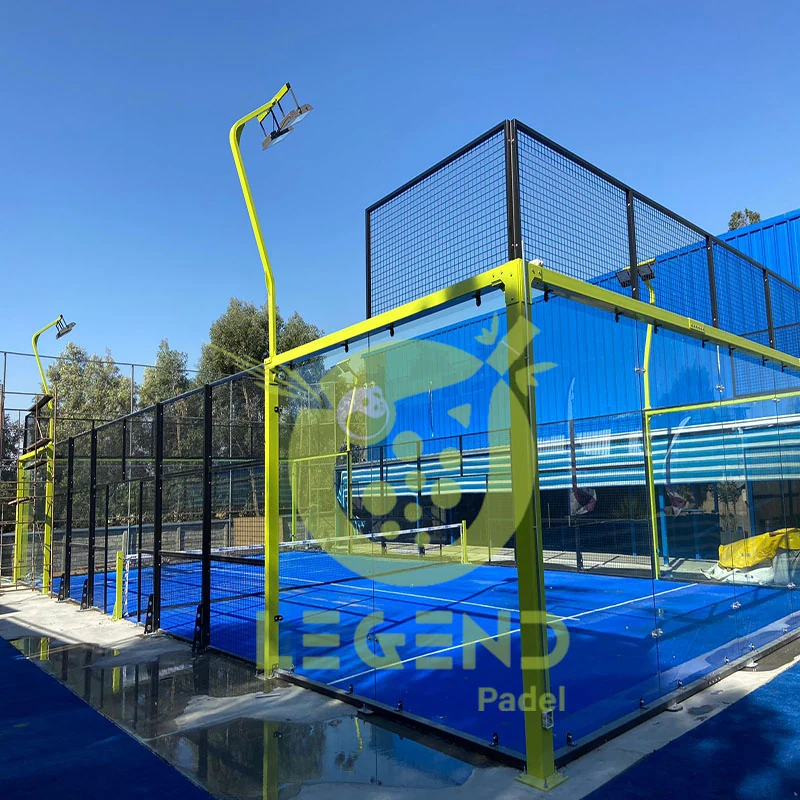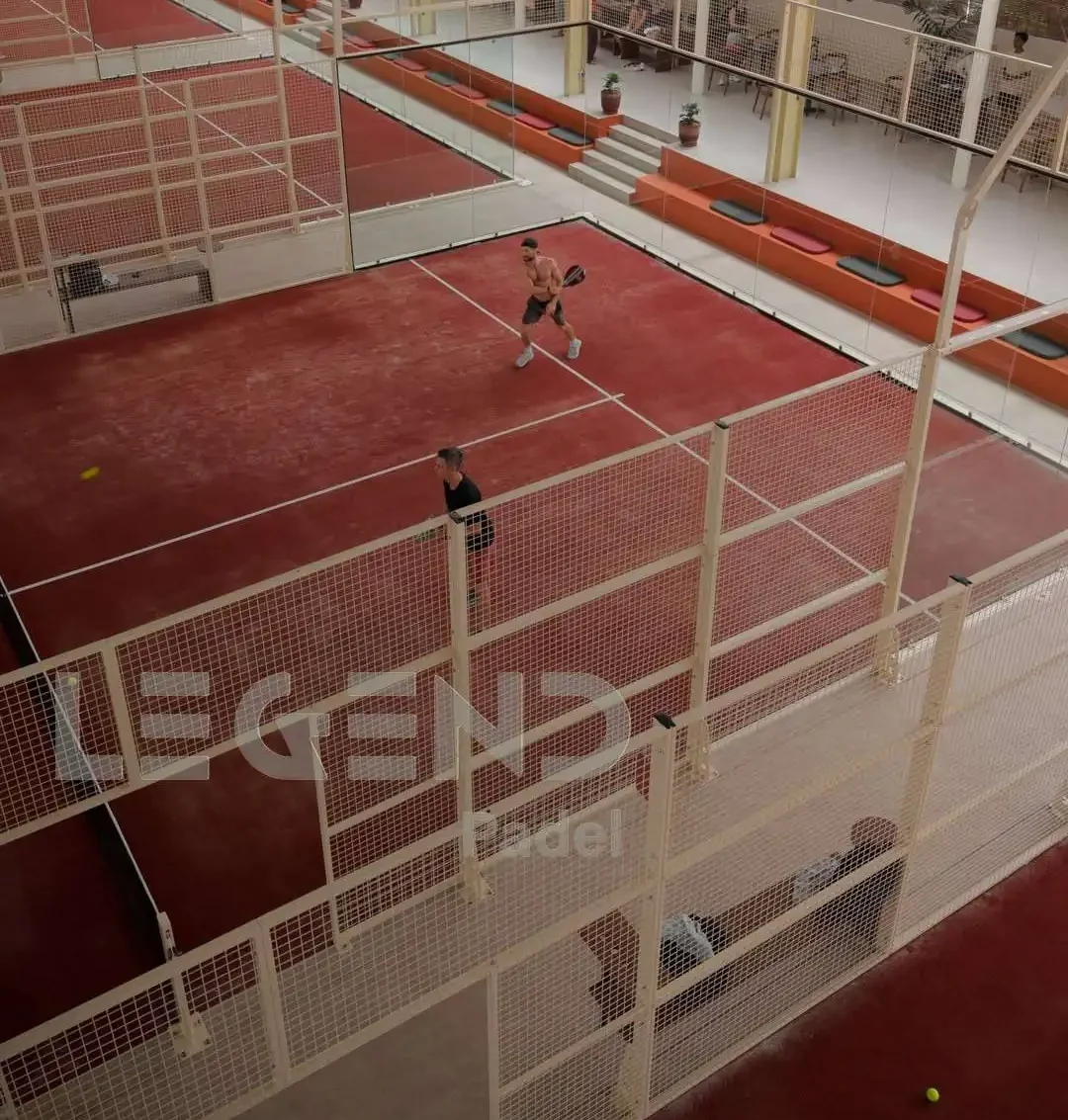



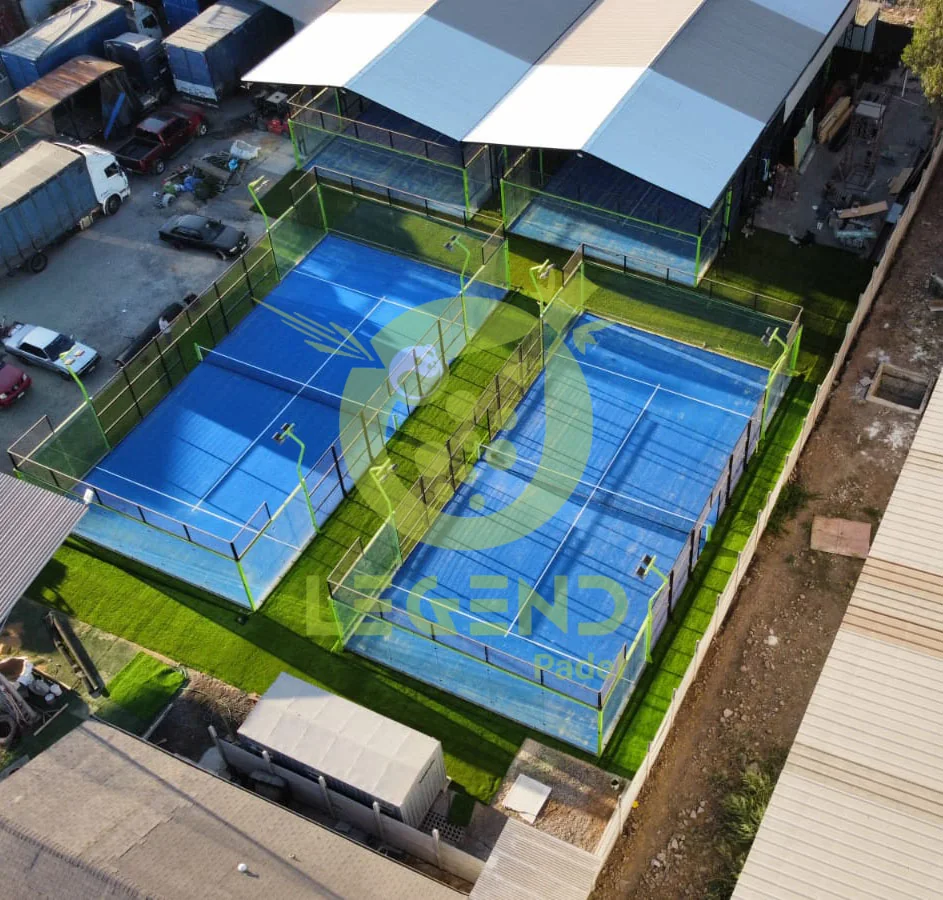
Germany’s padel court market is moving toward structured growth. The 2025 Global Padel Report recorded more than 50,000 courts worldwide in 2024, up 17% year on year, and a 48% rise in Germany’s gross booking value per court. Strong projects now prove acoustic compatibility before fixing the layout and budget.
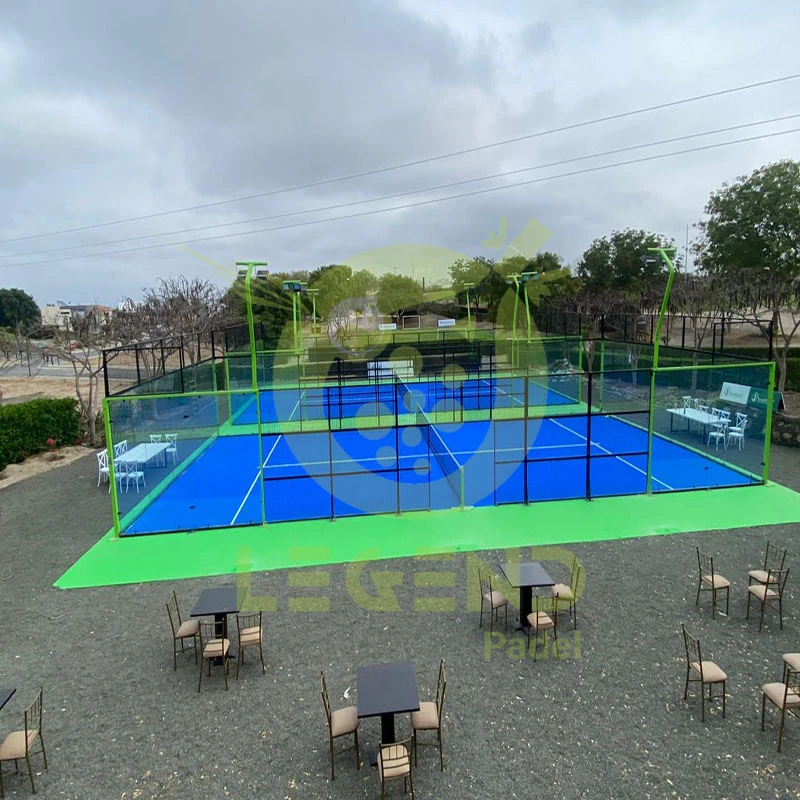
For a padel court in Germany, noise approval is a site-planning issue. Ball strikes, enclosure contact, voices, spectators, parking, and traffic can all influence the assessment. Walls are usually made of tempered glass, while the remaining enclosure uses ball-retaining mesh, so sound direction matters.
What German noise rules apply to a padel court?
Why the 18. BImSchV is the starting point
Germany has no padel-only permit. A fixed sports facility generally falls within the Federal Immission Control Act and the 18. BImSchV sports-facility noise ordinance. Section 22 requires avoidable harmful effects from non-permit-requiring facilities to be prevented and unavoidable effects minimized. The ordinance supplies area- and time-specific immission guide values.
A German padel court permit cannot be judged from one universal decibel number. Confirm the land-use category, assessment period, existing sports noise, and local route with the Bauamt and immission-control authority.
Which noise sources and receivers enter the review?
The assessment method attributes noise from players, spectators, equipment, and on-site parking to the sports facility. Associated public-road traffic is considered separately in specified circumstances. The decisive receiver is normally the most affected protected location, not a convenient court-boundary point.
Therefore, padel court noise regulations in Germany should shape the whole site plan. A quiet residential facade or future buildable plot may matter more than the average sound level across the property. Operating hours and simultaneous court use can also change the result.
How does an acoustic assessment support padel court approval?
What should the baseline survey and model include?
A credible acoustic assessment for a padel court measures the existing environment during the proposed operating hours. A qualified acoustician identifies sensitive receivers and models the courts, player activity, parking, and access. Each direction needs testing because glass ends and mesh sides radiate sound differently.
The report should state the assumed court use, opening hours, events, vehicle movements, and mitigation measures. A source value without a measurement position, direction, and operating context provides weak evidence.
How can the report become an approval-ready operating plan?
Alternative layouts should be compared before one arrangement is frozen. Court rotation, social-area position, access routes, evening hours, and correctly placed barriers can then be tested. This turns padel court approval in Germany into a documented design process.
Predictions should be connected with drawings and operating commitments. Restricted hours, event limits, or verification duties can then be transferred into booking rules, staff procedures, and post-opening monitoring.
Which site-planning decisions reduce padel court noise before installation?
Use distance, orientation, and existing shielding first
Effective padel court site planning maximizes separation from protected facades, avoids aiming exposed sides toward homes, and uses existing buildings or landforms as shielding. Where several courts are planned, the acoustic model should treat the cluster as a combined source.
Parking, entrances, terraces, and waiting zones need the same attention. Moving a court while leaving late-evening arrivals beside a quiet boundary is incomplete planning. Further German project considerations are covered in How to Build a Padel Court in Germany Without Noise Approval Headaches.
Add mitigation and operating controls as a coordinated package
Where distance is limited, noise mitigation for padel courts may combine acoustic barriers, vibration isolation at enclosure connections, reduced use during sensitive periods, event controls, and a complaint-response plan. Gaps, barrier position, reflections, upper-floor receivers, wind, and access openings can all influence performance.
An indoor conversion replaces open-air propagation with sound-breakout and reverberation questions. The actual enclosure, doors, ventilation openings, and operating pattern should be tested because an indoor label alone does not guarantee approval.
Indoor or outdoor padel court in Germany: which is easier to approve and budget?
Compare indoor and outdoor cost drivers
An indoor padel court cost includes the lease or conversion, fire and use-class reviews, clear height, ventilation, lighting, acoustic treatment, and sound-breakout control. Potential benefits include year-round operation, fewer weather cancellations, and greater control over sound reaching nearby receivers.
An outdoor padel court cost may begin with lower building overhead. However, acoustic modeling, climate-load calculations, drainage, barriers, lighting review, and restricted operating hours can increase the approval budget.
Budget for approval risk, installation, and lifecycle value
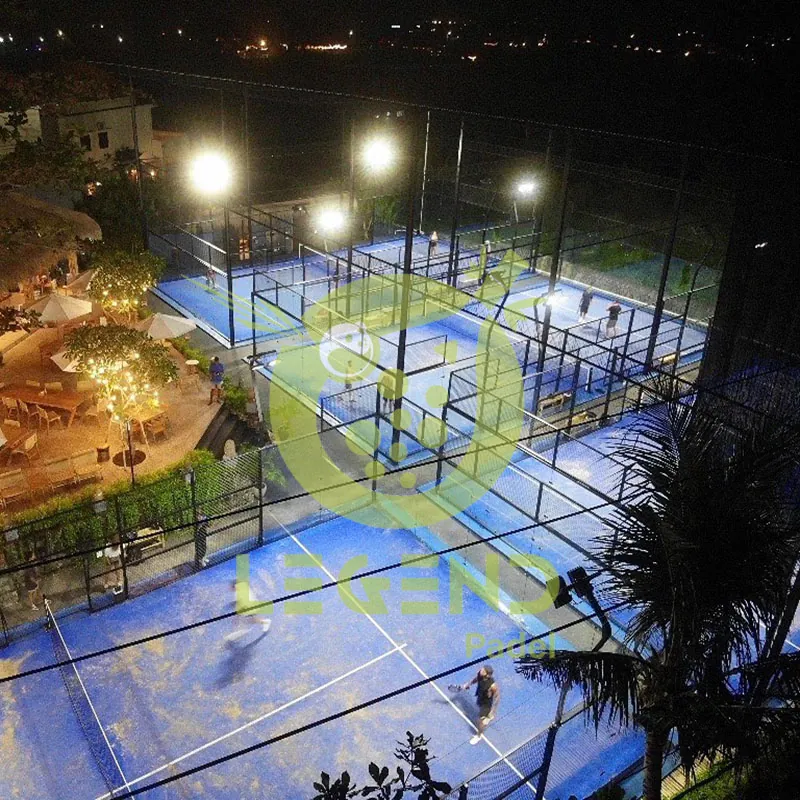
The comparison should cover the purchase price, reports, revisions, site preparation, installation, energy use, maintenance, weather downtime, later acoustic work, and revenue available during approved hours. A cheaper outdoor plan that loses evening bookings may generate less lifecycle value than a higher-cost indoor location.
Mobility does not remove local planning duties. On a suitable approved site, the Mobile Pro Padel Court-PD05 is self-fixing, protects the existing floor, and supports easier assembly and disassembly. This flexibility should be presented as an installation and asset-management benefit, not as a permit exemption.
How should a German padel court project move from approval to installation?
Follow an approval-first installation sequence
A reliable padel court installation in Germany follows a clear order: confirm land use and the application route; obtain an early authority view; survey noise and sensitive receivers; compare layouts; agree on operating assumptions; complete acoustic, structural, lighting, parking, and access documents; and then release the approved design for production.
Once the site logic is fixed, product selection becomes more precise. At LEGEND SPORTS, we use the approved layout, climate data, and operating model to prepare a customized padel court solution.
Match the court model to the site evidence
For standard layouts, the Pro Panoramic Padel Court-PD04 provides a 20 m by 10 m playing area, 12 mm tempered-glass walls meeting EN 12150-1, and eight 200 W lights. Its panoramic visibility suits indoor and outdoor venues where the approved orientation and lighting plan support its use.
Higher wind exposure may require a stronger configuration. The Max Pro Panoramic Padel Court-PD03 uses 150 mm by 150 mm corner columns while retaining the same court size, 12 mm tempered glass, and eight-light arrangement. Final load calculations, acoustic measures, colors, logos, and access details can form a customized padel court design.
Before opening, the project team should verify orientation, barrier continuity, enclosure connections, lighting aim, and approved operating hours. Post-opening measurements and an operating log can identify and resolve small issues before they develop into repeated complaints.
FAQ
Q: Does a padel court need planning permission in Germany?
A: In many cases, yes, but the route depends on the German state, municipality, land use, building changes, lighting, operating hours, and whether the facility is fixed or temporary. The local Bauamt should be consulted before ordering the court or preparing the site.
Q: When is a noise assessment required for a padel court in Germany?
A: The authority may request an assessment when homes or other sensitive receivers could be affected, when several courts will operate together, or when evening use, parking, and events increase the risk. Early assessment is usually safer than waiting for a formal request.
Q: How far should a padel court be from houses in Germany?
A: There is no single nationwide distance that guarantees approval. The answer depends on zoning, background sound, court orientation, number of courts, operating hours, shielding, and the relevant immission values. A site-specific acoustic model provides the most defensible answer.
Q: Is an indoor padel court quieter than an outdoor court?
A: It can reduce outdoor sound propagation, but actual performance depends on the building envelope, doors, ventilation openings, and internal reverberation. An indoor project may still require an acoustic review where nearby sensitive receivers could be affected.
Q: Which padel court model suits a German outdoor project?
A: The approved site evidence should guide the decision. A standard panoramic layout may suit a sheltered club, a stronger PD03 configuration may suit higher climate loads, and the PD05 may support an approved leased or relocatable strategy. Local structural and acoustic calculations remain essential