



Three courts or four? A weekly booking grid helps: enter the visits expected in each window, then compare their court hours with available time. Repeat the calculation for busy periods. Use the larger result, rounded up. In the example below, three courts have weekly capacity, yet the evening schedule calls for four. Groups seeking evening slots cannot use morning vacancies.
How Do You Convert Weekly Padel Demand into Court Hours?
Count Player Visits, Not Just Members
Record each member’s visit frequency: a twice-weekly player consumes twice the time of a weekly player. For doubles bookings:
Court hours = player visits × session hours ÷ four players.
The 300 weekly player visits, at 90 minutes each, require 112.5 court hours in full doubles groups. Do not divide bookings already expressed as court hours.
Separate Open Play from Coaching and Events
Which coaching, league and corporate reservations are already counted? Add only activities missing from the estimate. Uncounted activities add 37.5 hours, giving total weekly demand of 150 court hours; assign bookings their requested windows. A broader padel club court planning guide can help distinguish court roles before assigning bookings.
How Much Bookable Time Does Each Padel Court Provide?
Deduct Closures and Booking Turnover
Cross out maintenance periods and time without staff cover on the opening schedule, allowing for weather if the courts are outdoors. What remains must accommodate complete reservations. A twenty-minute gap between bookings cannot hold a ninety-minute booking, although it appears as vacant time. This example leaves 84 bookable hours per court each week.

Give weekdays columns and booking windows rows. Keep fixed lesson blocks marked occupied, so the grid shows remaining spaces for leagues, social play and private reservations. Does each group fit its preferred window? Keep confirmed commitments distinguishable from enquiries when assessing a new club whose membership is projected.
Choose a Planning Occupancy Assumption
What availability should remain for a player choosing a booking? The planning occupancy assumption is 70% across the week, equivalent to 58.8 hours per court. It leaves time unfilled. Change that input when testing the model. This assumption cannot establish an industry benchmark, predict sales or supply bookings for an additional court.
How Many Padel Courts Does Your Peak Demand Require?
Calculate Weekly and Peak Capacity Separately
The required count follows from this division:
Required courts = demand hours ÷ (bookable hours per court × planning occupancy), rounded up.
Weekly demand divided by capacity, 150 ÷ (84 × 0.70) = 2.55, needs three courts. But 72 of the 150 hours are requested within 24 peak hours per court. At the 80% peak occupancy assumption, 72 ÷ (24 × 0.80) = 3.75: four courts. The 72 hours already count towards weekly demand.
Test a Three-Court and Four-Court Scenario
| Scenario | Planned weekly capacity | Planned peak capacity |
| Three courts | 176.4 hours | 57.6 hours |
| Four courts | 235.2 hours | 76.8 hours |
The booking grid points to four courts, but the site review and budget must support that number. Check individual evenings as well: simultaneous lessons and matches can exceed a weekly peak average. A vacant Tuesday morning cannot absorb a Friday booking unless players agree to move.
Run a sensitivity test before accepting four courts. Reduce peak demand to 54 hours: three courts offer 57.6 planned peak hours, enough. Demand of 84 hours puts four courts beyond the occupancy limit. Write achievable revenue beside the investment and operating costs. Does the capacity decision make financial sense on these figures?
Can Your Site Support the Court Capacity You Need?
Check Layout and Circulation Before Fixing Court Numbers
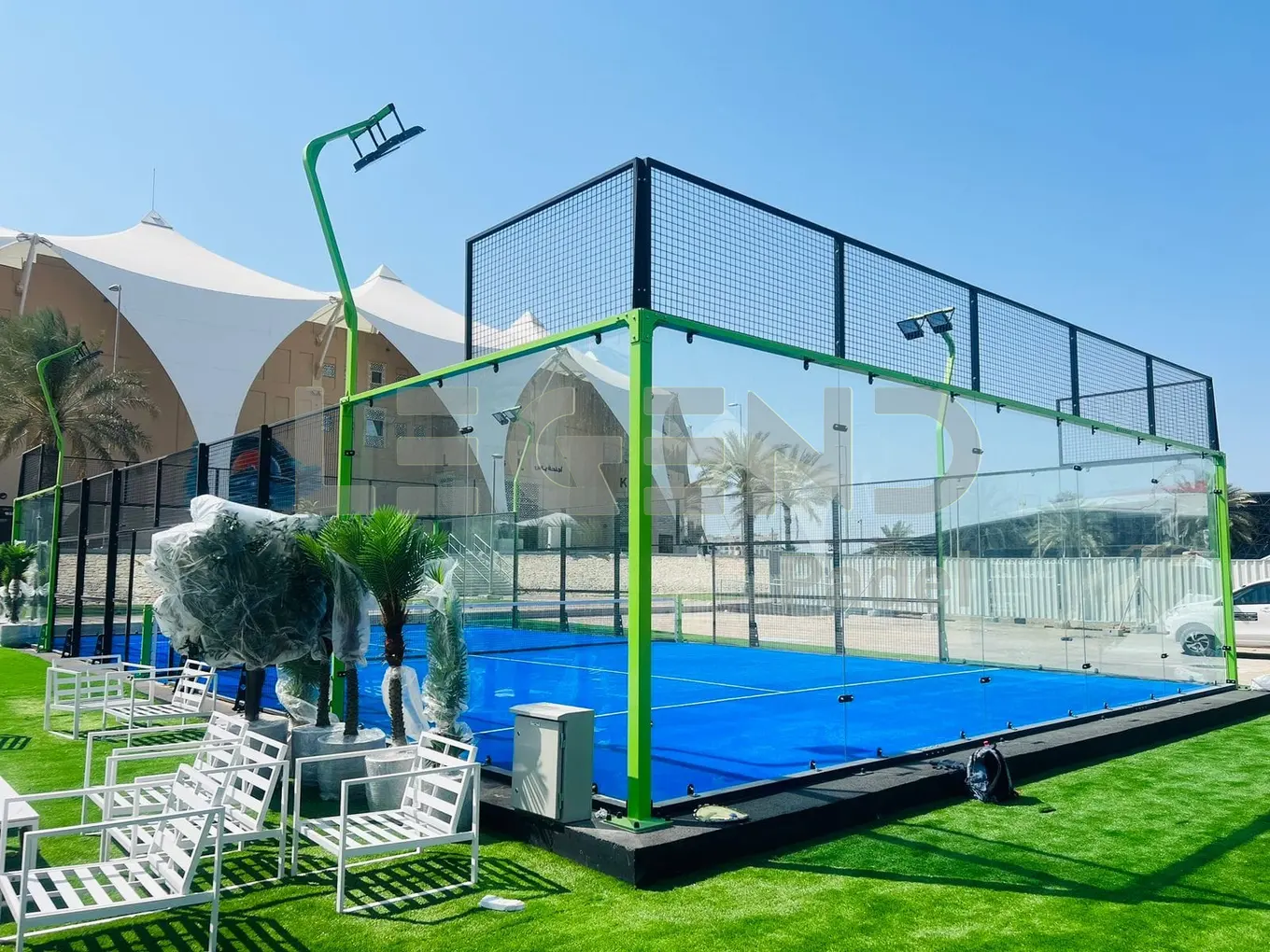
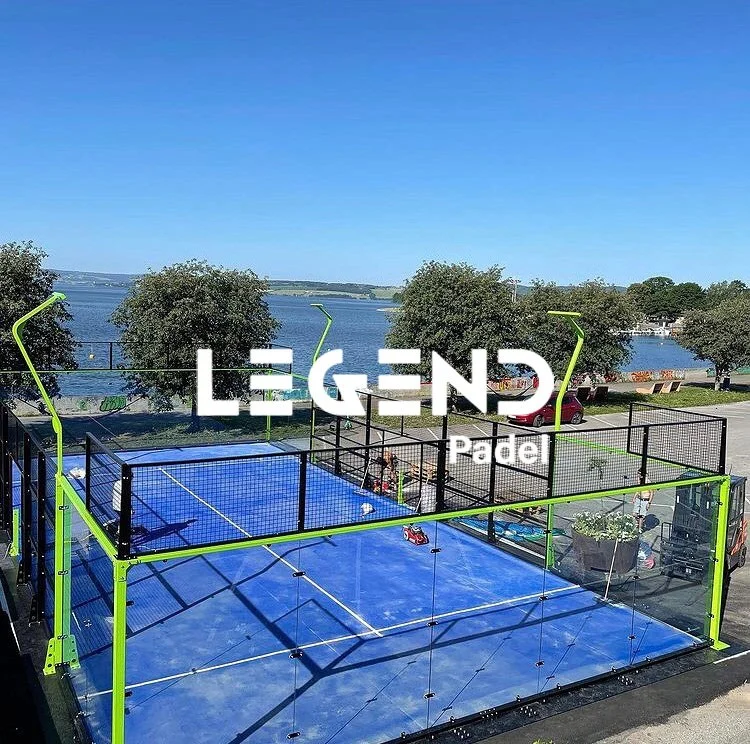
Planning at LEGEND SPORTS can begin with an indoor, outdoor, rooftop or conversion site. Single-court, multi-court and club layouts can cover court arrangement, structural solutions, lighting, drainage and foundations, with spectator areas and pedestrian circulation planned alongside.
Use the booking format when comparing the padel court range. Do not treat every court configuration as interchangeable in the demand model. Protect access and waiting space when checking whether the fourth court fits.
Match Ground Conditions to a Feasible Foundation
Наши Модульная система фундамента для кортов для падела is intended for uneven and sloping ground. Its adjustable support feet have a 150–800 mm adjustment range and can compensate for elevation differences to help create a level foundation platform. This can reduce extensive levelling work; it does not mean every site can avoid civil works or assessment.
The project process starts with the location, site conditions, number of courts and preferred court model. We evaluate the site and foundation requirements, then develop a customized foundation solution. The approved specifications guide component manufacture before shipment preparation and installation support.

When Should a Padel Club Add Another Court?
Track Unmet Demand Before Expanding
Record the declined enquiry’s day, start time and duration beside the group making it. Members asking for the same group represent one lost booking. Note whether they accept another time. Review representative weeks across seasons. A full calendar on one evening is a reason to investigate, not evidence to order another court.
Match dates in the demand and supply records. Check each cancellation: did it leave time blocked or let another group book? Record whether waitlisted players found another booking that week before treating requests as lost demand.
Prepare the Next Phase and Installation Handover
Identify expansion access before approving the initial layout. For installation, we provide detailed installation drawings and step-by-step installation manuals. Video guidance and remote engineering support are also within the support scope. Coordination with a local installation team remains optional.
After-sales support includes expansion and upgrade planning and technical consultation. For upkeep, support covers spare parts, turf and glass replacement assistance, and maintenance and inspection guidance. Agree service responsibilities in the contract.
Assess tournament requirements separately from the weekly booking schedule. Compare hiring temporary event capacity with adding another court that needs demand throughout normal operations.
Bring a weekly demand grid, peak schedule and site plan to the next project discussion. These inputs turn a court count into an assessable proposal.
Часто задаваемые вопросы
Q: How many padel courts does a club need?
A: Use the weekly calculation and the peak calculation. The larger rounded-up result sets the requirement; another location or operating model can produce a different count.
Q: How many players can one padel court accommodate?
A: Four players share a doubles session; weekly player capacity is four times the sessions filled. Use available booking hours and session length to count slots, apply the occupancy assumption, and allow separate space for coaches and spectators.
Q: How do I calculate padel court occupancy?
A: Select the review dates. For those dates, booking records supply occupied court hours. Divide that figure by bookable court hours and multiply by 100; use peak and off-peak occupancy to check evening availability.
Q: Are three padel courts enough for a club?
A: Check how peak slots fill. Three courts cover the weekly demand in this example, but too many groups want the same peak slots. The schedule needs four.
Q: When should a padel club add more courts?
A: Check whether declined groups return with the same request because alternatives remain unsuitable. Then check whether another court fits the site and can justify its costs.