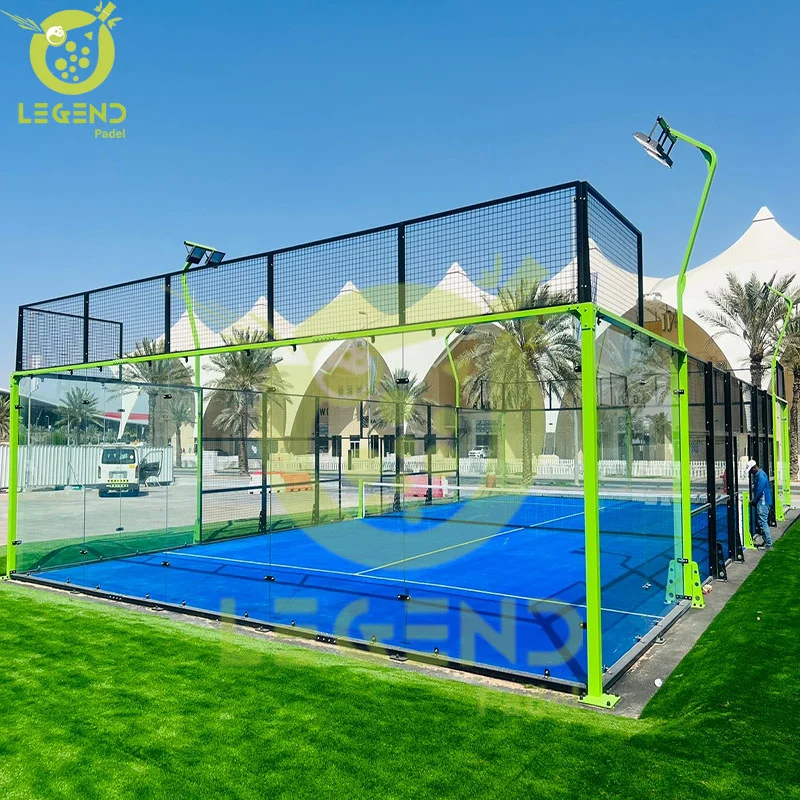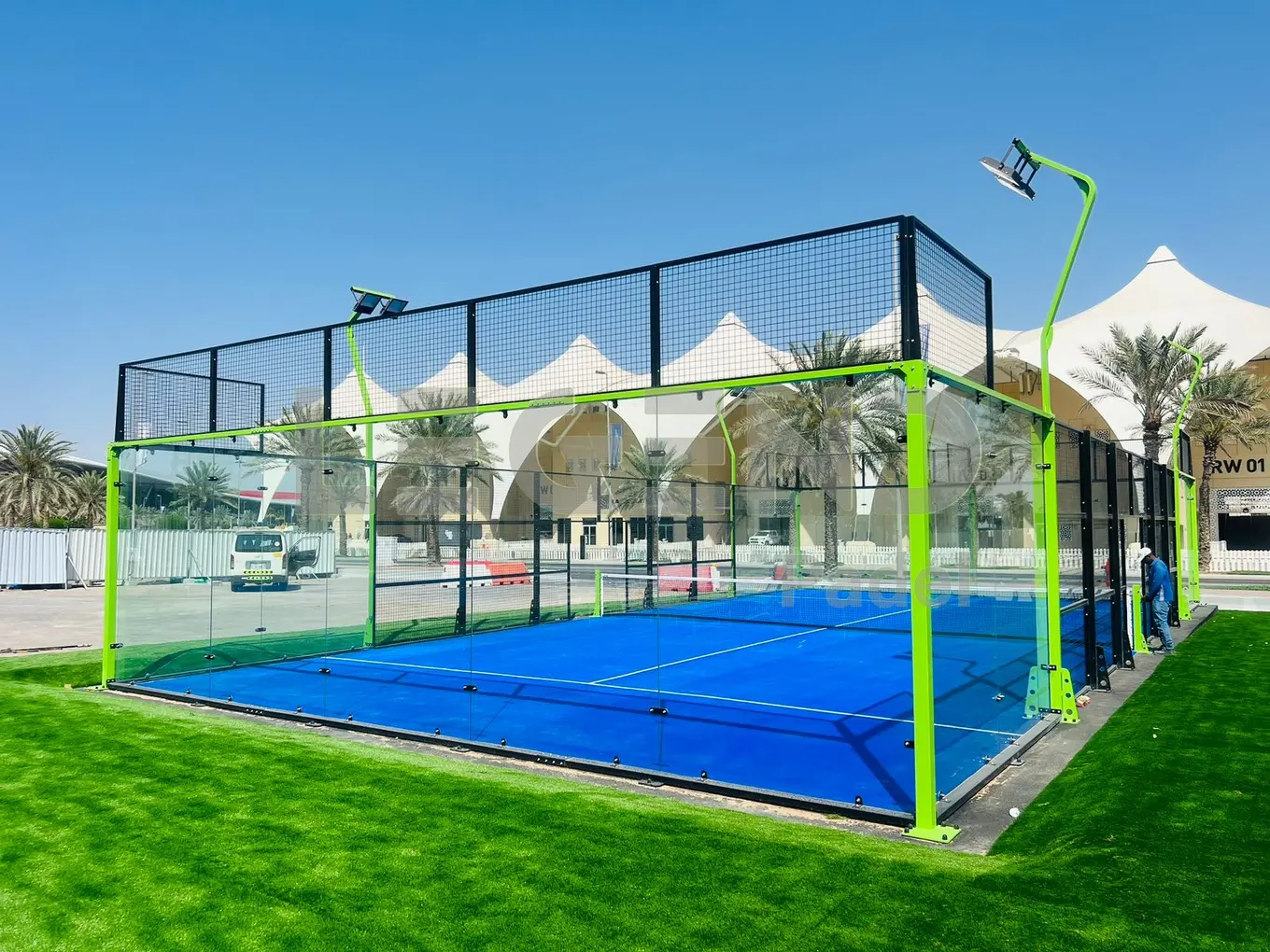



A Padel Court turnkey solution is valuable when a commercial project has several handoffs: site planning, court selection, shipping, assembly, acceptance, and after-sales support. One-stop service connects those responsibilities in one controlled brief.
What a Turnkey Padel Court Solution Should Include
Define the connected scope
The scope of work for a turnkey delivery should start with the venue information and end with a practical handover note. In addition to the court selection, the scope of work may also include drawings, material information, export packing, shipping documents, installation notes, test reports, and contact details of the support staff. The contract and Incoterms should clearly state what is included in the scope of work and what is not, and whether something is optional or to be procured locally.
A turnkey padel court project is much easier to manage if a clear handover path is agreed. Use this path to test the reality of your ‘one-stop’ scope.
Use one project brief
Combine all the necessary information for your venue such as venue type, number of courts, site constraints, access, drainage, lighting, delivery route and opening sequence in one controlled brief. LEGEND SPORTS planning support links the layout discussion with the issues surrounding delivery and installation, and your chosen operator can confirm local contractors and relevant approvals.
State the decision to be made by each party in the brief. For example, the operator can own the booking assumptions, the site team can own the access readiness, and the supplier can own the quoted court configuration that you will vary later. This will assist in costing and approving later variations.
For a product reference, see the Полная панорамная страница товара «Педель-корт». The linked product is a reference point; the turnkey scope still needs to be written for the actual site.
Benefit One: Fewer Interfaces During Design
Coordinate layout and specification together
Even when all choices are with the same party, the Court choice, the Foundation assumptions, the Lighting position, and the Access route can cause much delay. By carrying out a connected design review, the buyer can see how these interact with each other. This allows the supplier to indicate which drawing is used for any particular quote and show the impact of any changes to materials, the proposed delivery date, and the installation guidance note.
Note that we’re shooting for traceability of decisions here rather than a fixed price or timeline. Each decision should have an owner, be revised as necessary, and then approved by said owner.
Make exclusions visible
Are local groundwork, power, drainage, unloading, equipment storage, and installation labor included in the offer or not? A one-stop quotation is easier to assess when exclusions are clearly listed as well as inclusions. Recommend a scope matrix with one row per handoff.
Benefit Two: Logistics Starts Before Dispatch
Choose the shipping conversation early
The LEGEND SPORTS export support includes the FCL or LCL shipping, export packing with reinforcement, optimization of the container, and all transportation to the port of departure. Depending on the selected Incoterms and contract conditions, the required export documentation may include a commercial invoice, packing list, bill of lading, certificate of origin, if required, as well as all required export customs documents and export customs clearance.
Delivery Scope for FCL and/or LCL shipment: export packing and delivery at the port as specified in the contract by the respective Incoterms.
Make sure you have a delivery address, unloading plan, and storage plan in place before dispatch. Ask how you will be able to identify the court that has been packed for you.
Protect the site schedule with a readiness check
Before dispatch to site, please check access width, lifting equipment, storage, working area, and component movement sequence to be able to maneuver components to the court position. If any of these assumptions change, please update the brief before sending it out to the carrier/installer.
Request the packing list in due time and compare it with the unloading plan. A commercial location, for example, might have a narrow service entrance, a certain time slot for delivery, and insufficient storage area that is protected from the weather. All these limitations need to be recorded when you order a turnkey padel court. The court cannot be installed if the location is not ready for the shipment of the court.
Benefit Three: Installation Support Makes Handover Testable
Give the installer usable information
Installation support can include detailed drawings, step-by-step manuals, video guidance, and remote engineer support. It is most useful when the documents identify the same parts, revisions, and acceptance points used in the quotation. The local installation team, when selected, should know which questions to return to the supplier and which remain local.
Coordination with a local installation team is optional and should not be assumed to be included.
В padel court installation process provides a useful sequence for discussing site and assembly responsibilities.
Write acceptance before assembly
A complete handover acceptance should refer to the approved layout, visible finishes, condition of glass and turf, correct position of lighting, access to all areas, presence of all operator manuals and any outstanding work to be completed by local contractors. Details of any deviations from the agreed specification and who is responsible for their closure should also be recorded by the handover operator and supplied in a small, handy file instead of a mass of individual messages.
It’s also useful to differentiate between a supplier’s fix and a local fix. This means that instead of accepting that an open drainage channel, lack of power, or lack of access is a deficiency of the court, it is recorded separately to the acceptance record, and the Venue Manager has a clear list of items to close prior to the first public let.
Benefit Four: Support Continues After Opening
Name the support route
After handover, the documented support scope can cover spare parts, turf or glass replacement support, maintenance and inspection guidance, expansion and upgrade planning, and technical consultation. Buyers should record what is included before production.
This record helps the operator to select the correct spare part, to ask the appropriate maintenance question, and to plan the second phase of maintenance. It clearly states whether a local specialist is required.
Keep the operating file current
Save approved drawings, the material schedule, the installation notes, the inspection notes, the support contacts, and any other local unfinished tasks with the venue team. We can provide technical support within the agreed scope of work, but the operating file must reflect the scope of work and who the next action owner is.
It’s important to keep this file available to people who schedule play and arrange maintenance, not just to procurement. It will be months down the line when a question arises regarding a replacement or expansion, and the operating team will need to be able to look back at the original configuration and agreed technical route for any questions.
The support route should be written into the handover record so the operating team can identify supplier and local responsibilities. The handover record should name the support contact and list outstanding local tasks.
Compare One-Stop Quotations in a Consistent Way
Build a scope matrix
When comparing competitive bids, list the design inputs, then the court configurations, then the foundation boundaries, then the packaging, shipping terms, unloading at site, installation instructions, acceptance tests, supply of spare parts, and future expansion in that order. Do not compare a complete delivery offer with a product offer.
For each row, indicate if the service element is included, optional, local, or to be defined. In this way, one-stop service can be measured. Where work has not yet been assigned, this is also clear.
Make a delivery checklist to list packaging, shipping documents, installation instructions, acceptance checklist, and contact details for support before you start producing.
Test the handover record
Request the supplier to provide a sample contents list for the final file. Verify that the sample contents list includes the approved drawing revision number, material schedule, padel court installation guidance, padel court inspection result, padel court support contact, and any outstanding local tasks. The padel court products page can help compare product categories, while the contract controls the turnkey commitment.
Часто задаваемые вопросы
Q: What is a Padel Court turnkey solution?
A: It is a well-coordinated scope of work from planning and supply of courts through to delivery, installation guidance, acceptance and after-sales support as agreed.
Q: Does turnkey service include local installation?
A: Detailed drawings, step-by-step manuals, and video online help are supplied as part of the installation support. Local installation can be included in the scope as required.
Q: What shipping support can be included?
A: The delivery scope could be a FCL or LCL shipment, including the export packaging with delivery at the port of departure. This would depend on the terms and conditions of the contract as well as the Incoterms to be used.
Q: What should a turnkey handover include?
A: A delivery checklist contains the following items that have to be identified before production starts: packaging material, shipping documents, installation instructions, test acceptance form, and contact person for any kind of support. The buyer has to note down all items that are delivered before production starts.
Q: Can turnkey service support a phased club expansion?
A: The first phase can collect data on compatible materials, optimal layouts, necessary maintenance, and assigned responsibilities.